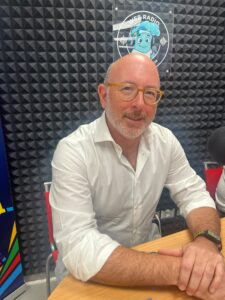
Interview with Stefano De Luca, UniSA Mobility Coordinator: “a tribute to the entire operations team”
A vast fleet of coaches, shuttle buses and service vehicles: a remarkable organisational effort that ensures the daily transportation of student-athletes, judges, referees, volunteers, EUSA staff and UniSA personnel.
“The figures are truly significant”, says Professor Stefano De Luca, UniSA Mobility Coordinator. “First of all – he adds – it is important to clarify that the scale of this event is comparable in many respects to the Summer Universiade and, in several aspects, even to the Mediterranean Games. I would like to emphasise this in order to acknowledge the outstanding work of the entire organisation, and particularly the transport sector, which has succeeded in developing a transport system of comparable complexity with a budget amounting to only about one-tenth of those allocated to the events I have just mentioned, while relying entirely on in-house resources. This is an achievement of great value, demonstrating efficiency and the ability to optimise the resources available. Our aim is also to generate a positive economic impact across the entire local system”.
This organisational effort guarantees daily transport connections not only for competitions and training sessions, but also for participants wishing to travel in the evening, whether to reach the city of Salerno or to visit Piazza del Sapere and enjoy the Fan Zone.
“The heart of this model – explains Professor De Luca – is our bus terminal, an infrastructure that already handles around 18,000 passenger movements every day for those using our campuses. During the Games, this is complemented by more than 13,000 daily users, including student-athletes, judges, referees, volunteers and all staff involved in EUG Salerno 2026. On average,” he continues, “35 coaches operate every day, providing nearly 300 journeys. Athletes pass through the terminal several times a day as they travel between competition venues, dining facilities and the various event locations. The terminal has therefore become a true mobility hub, an interchange where passengers board and disembark buses arriving from different routes”.
“I would like to take this opportunity to congratulate the entire operations team, which has been working around the clock. This morning, for example, staff were already on duty at 2:00 a.m. to ensure the first departures of the day. I therefore want to thank everyone involved: highly skilled, experienced and always helpful professionals. Without their commitment, the transport service we see operating today simply would not exist”.
This extensive effort has been carefully tailored to meet the complexity of the territory and, in particular, to address the logistical challenges associated with accessing some of the competition venues.
“From an operational perspective we planned three different categories of buses. Thanks to the many site inspections we carried out, we discovered roads and sports facilities that many people were not even aware existed: this too is one of the strengths of our territory. Every transport company involved had to integrate rapidly into a highly complex environment, become familiar with its characteristics and adapt its services to the specific requirements of the event. The area covered is extremely large, stretching from Eboli to Avellino, including the Agro Nocerino-Sarnese district. Such a broad geographical distribution inevitably results in a highly fragmented transport network, making the organisation of mobility particularly challenging. In a context like this everything must work with the precision of a Swiss watch”.
It is time to take stock of EUG Salerno 2026, the eighth edition of the European Universities Games, organised – for the first time ever in Italy – through the outstanding joint efforts of the University of Salerno, CUS Salerno and ADISURC, with the support of FederCUSI and the Campania Region.
On the final day of EUG Salerno 2026, European university titles were awarded in beach volleyball, tennis, football, badminton, 3×3 basketball, and handball.